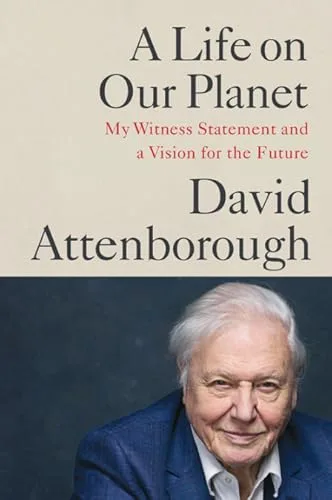
A Life on Our Planet: My Witness Statement and a Vision for the Future
At ninety-four, David Attenborough utilizes his career as a naturalist to document the decline of Earth’s biodiversity. He begins with his 1937 visit to a prehistoric site and charts the subsequent rise of atmospheric carbon and the loss of pristine wilderness. The narrative provides data on the shrinking holocene stability, the acidification of oceans, and the destruction of tropical rainforests. Attenborough argues for a transition to renewable energy, the restoration of kelp forests, and a shift toward plant-based diets to rewild the planet and stabilize the global temperature.
Environmental scientists and students of ecology read this to understand the specific correlation between human population growth and species extinction. The text provides a framework for sustainable living, moving from high-impact industrial farming to regenerative agriculture. Readers walk away with a timeline of planetary change and a checklist of technical solutions required to prevent a sixth mass extinction. It serves as a scientific record of the twentieth century and a strategic map for ecological recovery in the twenty-first.
- Published
- 2020
- Language
- EN