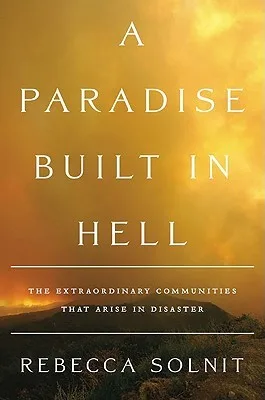
A Paradise Built in Hell: The Extraordinary Communities That Arise in Disaster
Rebecca Solnit investigates how people respond to major catastrophes, focusing on the five specific case studies of the 1906 San Francisco earthquake, the 1917 Halifax explosion, the 1985 Mexico City earthquake, the September 11 attacks, and Hurricane Katrina. She argues that in the immediate aftermath of disaster, social hierarchies dissolve and a spontaneous, egalitarian communalism emerges. Instead of descending into chaos or predatory behavior, citizens typically engage in mutual aid, self-organization, and altruistic cooperation. This "disaster utopia" represents a temporary reprieve from the atomization of modern life and reveals a latent human desire for connection and purpose that is often suppressed by institutional structures and elite panic.
Social scientists, community organizers, and urban planners read this book to understand the mechanisms of civil solidarity and disaster resilience. It serves as an analysis of human nature that contradicts the common assumption that people are inherently selfish or prone to panic without top-down authority. The reader learns that external institutional intervention often hinders rather than helps grassroots recovery efforts. By the end, the audience understands that the sense of belonging found in crisis provides a blueprint for how society might function during normalcy if people prioritized mutual reliance over competitive individualism.
- Published
- 2009
- Language
- EN
More by Rebecca Solnit
See all →



Readers also enjoyed