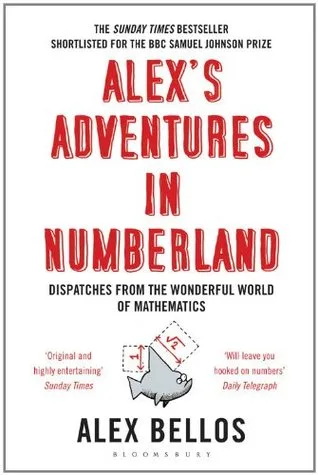
In this global survey of mathematical culture, Alex Bellos visits the Amazon to interview the Munduruku, a tribe whose language lacks words for numbers larger than five. He investigates the mechanics of the Japanese soroban abacus and speaks with mental calculators who perform complex arithmetic at high speeds. The text explains the geometric properties of origami, the statistical probability behind gambling streaks, and the cognitive science of how the human brain perceives logarithmic scales versus linear ones. Bellos details the development of non-Euclidean geometry and the historical evolution of the number zero through various civilizations.
This book serves students and enthusiasts who find traditional textbooks dry but remain curious about the origins of numerical logic. Readers learn how primitive counting systems evolved into modern calculus and gain a clearer understanding of how abstract patterns manifest in the physical world. Most audiences finish the book with a practical grasp of mathematical paradoxes and the ability to recognize how quantitative frameworks shape everyday social structures and historical progress. It provides a technical but accessible foundation for anyone interested in the intersection of anthropology and exact science.
- Published
- 2010
- Language
- EN
More by Alex Bellos
See all →
Readers also enjoyed