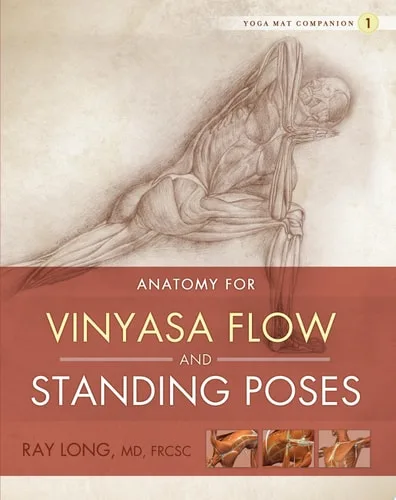
Anatomy for Vinyasa Flow and Standing Poses by Ray Long, Raymond A. Long (MD.)
Insights from Anatomy for Vinyasa Flow and Standing Poses
“When the agonist contracts, the nervous system sends a signal to the antagonist to relax.”
Every muscle has a partner that has to let go for you to move. Tension in your hamstrings usually means your quads aren't firing enough to signal a release.
Engaging your feet actually stabilizes your pelvis through a chain of connective tissue. It makes the whole body feel integrated instead of floppy.
“Use the muscles to create space in the joints.”
Small adjustments in the angle of your hip can take pressure off the lower back instantly. It turns out alignment is just physics applied to your joints.
The way your thigh bone sits in the socket changes how deep you can squat. No two people have the same hip anatomy so no two poses look identical.
- Published
- 2010
- Publisher
- Bandha Yoga Publications LLC
- ISBN
- 9781607439431
- Language
- EN
Readers also enjoyed