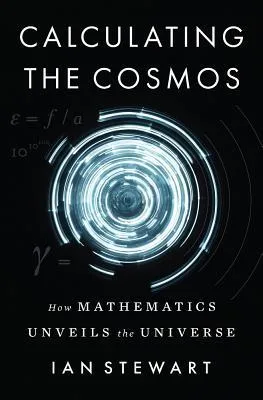
Calculating the Cosmos: How Mathematics Unveils the Universe
Ian Stewart traces the historical and conceptual evolution of cosmology through the lens of mathematical physics. He examines how celestial mechanics progressed from Kepler’s laws of planetary motion to Newtonian gravitation, and eventually to Einstein’s general relativity. The text explains the mathematical underpinnings of the Big Bang model, dark matter, and dark energy, while addressing the formation of the solar system and the chaotic dynamics of asteroid belts. Stewart details how specific equations allowed astronomers to predict the existence of unseen planets and quantify the expansion of space-time.
This book is intended for enthusiasts of physics and astronomy who want to understand the logic behind modern astrophysical theories. Readers gain a technical perspective on how abstract geometry and calculus translate into physical observations of black holes and galaxy clusters. By following the derivation of these ideas, the audience learns to distinguish between established scientific observations and speculative theories like string theory or the multiverse. You walk away with a clear grasp of how numerical models provide the evidence for our current map of the universe.
- Published
- 2016
- Language
- EN