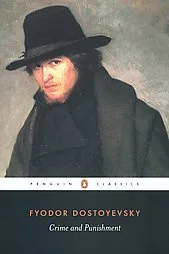
Crime and Punishment
Rodion Raskolnikov, a destitute former student living in a cramped St. Petersburg Garrett, formulates a theory that superior individuals possess the right to bypass moral laws for a higher purpose. To test this hypothesis, he murders an unscrupulous pawnbroker with an axe, but the subsequent accidental killing of her sister shatters his composure. The narrative follows his mental unraveling as he evades the investigator Porfiry Petrovich, whose psychological tactics increase the pressure on Raskolnikov’s fractured conscience. His internal isolation only begins to crack through his interactions with Sonya, a young woman forced into prostitution who advocates for suffering as a means of atonement.
Classic literature enthusiasts and students of psychology read this work to examine the mechanics of guilt and the failure of nihilism. The reader gains a granular view of a mental breakdown and the specific ways rationalizations collapse under the weight of human empathy. By the end, the audience understands the conflict between intellectual arrogance and the necessity of social and spiritual connection. The book provides a detailed map of a criminal mind seeking a path back to humanity through confession.
Insights from Crime and Punishment
“Am I a trembling creature, or have I the right?”
Intellectual pride can make a person do terrible things. Raskolnikov thought he was a genius but he was just lonely.
“I did not kill a human being, but a principle!”
Raskolnikov spends the whole story trying to justify a murder with logic. He finds out that his own conscience doesn't care about his theories.
The heat and the smell of the St. Petersburg slums feel like a fever dream. You can physically feel his paranoia growing in that tiny room.
“We shall see each other again.”
Sonia has every reason to be bitter about her life. Instead she carries everyone else's pain without a single complaint.
- Published
- 1866
- Publisher
- Vintage
- ISBN
- 9780307829603
- Language
- EN