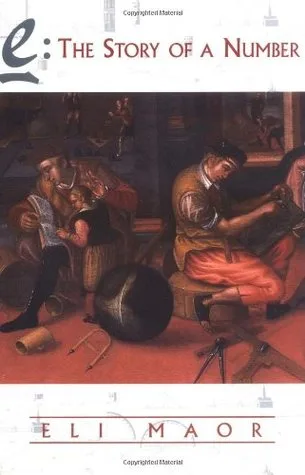
Eli Maor traces the history of the irrational number $e$ from its origins in seventeenth-century finance to its central role in modern calculus. The narrative focuses on John Napier’s invention of logarithms and the subsequent work of Jakob Bernoulli regarding compound interest. Maor explains the mathematical derivation of the constant through limits and infinite series, showcasing Leonhard Euler’s discovery of the identity connecting $e$ to trigonometry and complex numbers. The text details how this value governs natural growth, radioactive decay, and the physical properties of the catenary curve.
This book is written for mathematics students and educators who want to understand the human history behind abstract formulas. Readers gain a technical understanding of why $e$ serves as the natural base for logarithms and how it differs from geometric constants like pi. By the final chapter, the reader can visualize the evolution of mathematical analysis and identify the specific intersections where physics and calculus rely on this transcendental number to describe the physical universe.
- Published
- 1993
- Language
- EN
More by Eli Maor
See all →


Readers also enjoyed