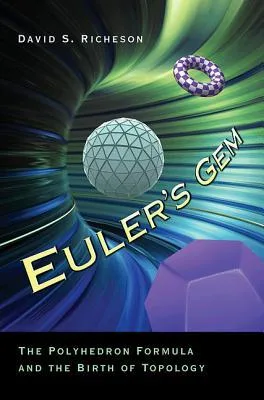
Euler's Gem: The Polyhedron Formula and the Birth of Topology
David Richeson traces the history of basic geometry from ancient Greek polyhedra to the flexible structures of modern topology. The central focus is Leonhard Euler’s 1750 discovery that for any convex polyhedron, the number of vertices minus the number of edges plus the number of faces always equals two ($V - E + F = 2$). The book explains how this elegant formula survived various counterexamples, such as nested solids and shapes with holes, eventually leading mathematicians to define the concept of the Euler characteristic and the formal study of invariants.
This book is written for math enthusiasts and students who want to see how a single formula can bridge rigid shapes and fluid surfaces. Readers learn how topology differs from classical geometry by focusing on properties that remain unchanged under stretching or bending. By the final chapter, the reader understands how Euler’s initial observation regarding simple solids provides the foundation for classifying complex manifolds and understanding the shape of the universe.
- Published
- 2008
- Language
- EN