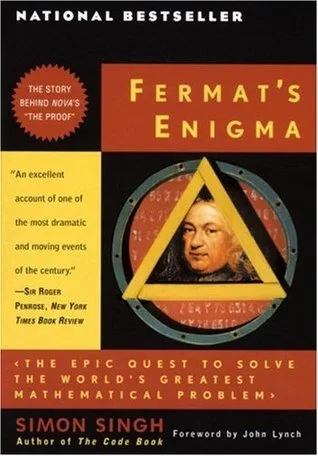
Simon Singh chronicles the three-century pursuit of a solution to Pierre de Fermat’s Last Theorem, a deceptively simple conjecture stating that no three positive integers a, b, and c satisfy the equation a^n + b^n = c^n for any integer value of n greater than two. The narrative traces the history of number theory from Pythagoras to the 17th-century margin note that sparked the mystery. Singh focuses on Andrew Wiles, the mathematician who spent seven years in isolation connecting modular forms and elliptic curves to settle the proof through the Taniyama-Shimura conjecture.
This book serves readers interested in the history of science and the logic of mathematical proofs. It attracts those who want to understand how abstract concepts like topology and game theory intersect to resolve ancient puzzles. Readers gain a technical Overview of how modern mathematics evolved from basic arithmetic to complex interconnected systems. They finish with a clear understanding of the rigors required to achieve absolute certainty in a logical framework and the persistence needed to overcome professional setbacks.
Outward-looking and clear-cut; a moderate read.
Best for readers like The Evidence Seeker. Which reader are you?
- Published
- 1997
- Language
- EN
More by Simon Singh
See all →

Books like Fermat's Enigma
See all 12 →