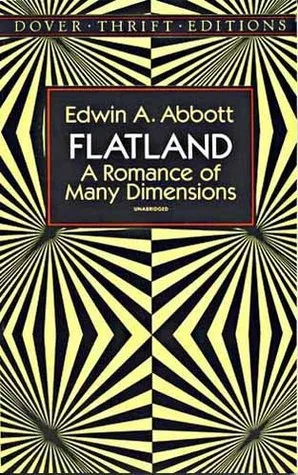
Flatland: A Romance of Many Dimensions
A Square, a mathematician and resident of a two-dimensional world, narrates his discovery of higher spatial realities. He describes a rigid social hierarchy where physical shape dictates class: women are simple lines, workers are triangles, and the ruling priests are circles. After a dream about the one-dimensional lineland, the protagonist is visited by a three-dimensional Sphere. This encounter forces the Square to grasp the concept of height, an impossible direction in his native plane, and leads him to hypothesize the existence of fourth and fifth dimensions.
Students of geometry and physics read this text to visualize spatial dimensions beyond human perception through analogy. It provides a framework for understanding how a lower-dimensional being might misinterpret phenomena from a higher plane as miracles or hallucinations. Readers gain a mental model for cross-sections and projections, learning to apply the logic of mathematical progression to theoretical physics. The book remains a foundational tool for those training their minds to think outside the constraints of three-dimensional Euclidean space.
Deep, outward-looking and thought-provoking; a moderate read.
Best for readers like The Deep Diver. Which reader are you?
Insights from Flatland: A Romance of Many Dimensions
“I was not a visionary. I was a Solid Being, a Circle.”
Square is stuck in two dimensions and can't even imagine a third. It makes me wonder what I'm missing right now just because my senses are limited.
“To be self-contained is the first law of the Aristocracy.”
Social status is determined by how many sides you have. The more complex you are, the more people respect you. It reminds me of how we label people based on titles.
“A single moment’s forgetfulness may make her a destroyer.”
Women are just straight lines in this world and they are considered dangerous. The fear of something you can't see coming is a really heavy theme.
“I am not a figure, but a Solid. You call me a Circle.”
The Sphere tries to explain 3D space to a 2D square. It is like trying to explain color to someone who has never seen light.
- Published
- 1884
- Language
- EN