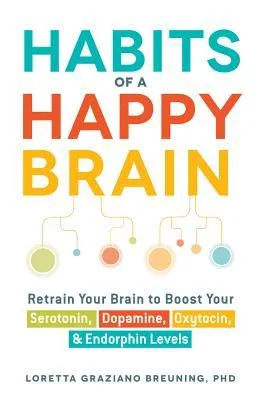
Habits of a Happy Brain: Retrain Your Brain to Boost Your Serotonin, Dopamine, Oxytocin, & Endorphin Levels
Loretta Graziano Breuning explains how the brain’s neurochemistry functions through the lens of mammalian survival. The text focuses on four primary chemicals: dopamine, which rewards seeking behavior; endorphins, which mask physical pain; oxytocin, which builds social trust; and serotonin, which triggers pride and status. Breuning argues that these "happy chemicals" are designed to release in short bursts rather than constant flows, often leading to a cycle of disappointment. By understanding the evolutionary purpose of these responses, readers identify how their brains prioritize physical survival over emotional satisfaction.
Individuals seeking a biological explanation for their moods will find these scientific practicals useful for building new neural pathways. The book caters to those who prefer biological mechanics over traditional positive thinking patterns. Readers learn to design specific forty-five-day plans to replace old reactive habits with intentional behaviors that trigger positive chemical releases. By the end, the reader possesses a roadmap for managing their own cortisol spikes and chemical dips through consistent, structural changes in daily routine.
Insights from Habits of a Happy Brain: Retrain Your Brain to Boost Your Serotonin, Dopamine, Oxytocin, & Endorphin Levels
“The brain does not give you a happy chemical unless it sees a way to meet a survival need.”
Your brain only releases happy chemicals in short bursts. Expecting a permanent high is actually fighting your own biology.
“Dopamine is the signal that you are about to meet a need.”
Dopamine is mostly about the anticipation of a reward. The feeling drops the second you actually get what you wanted.
“Endorphin is the brain’s mask for physical pain.”
Crying releases endorphins to help mask physical pain. It makes sense why a good sob feels like a physical relief afterward.
“The brain rewards you with oxytocin when you find safety in numbers.”
Oxytocin creates a feeling of safety within a group. It explains why being excluded feels like a literal threat to our survival.
- Published
- 2015
- Publisher
- Adams Media
- ISBN
- 9781440590504
- Language
- EN
More by Loretta Graziano Breuning
See all →
Readers also enjoyed