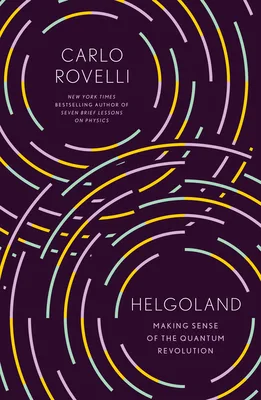
Carlo Rovelli begins on the desolate Island of Helgoland, where Werner Heisenberg first formulated the mathematical framework of quantum mechanics in 1925. The text details the shift from classical physics to a world where properties of subatomic particles do not exist independently of interactions. Rovelli argues for a Relational Interpretation of quantum mechanics, suggesting that reality is not composed of solid objects, but consists entirely of a web of relations. He examines the philosophical implications of entanglement and the collapse of the wave function through this lens.
This book is intended for readers who want to understand the physical world without relying on the many-worlds hypothesis or hidden variables. It appeals to those interested in the overlap between theoretical physics and Buddhist philosophy or continental thought. Readers gain a specific conceptual framework for visualizing how matter arises from interactions rather than substances. By the end, the reader possesses a clear definition of relational reality and a historical perspective on the internal struggles of the pioneers of the Copenhagen interpretation.
- Published
- 2020
- Language
- EN