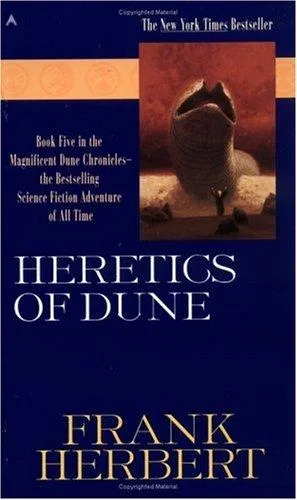
Fifteen hundred years after the death of the Tyrant, humanity returns from the Scattering to a transformed galaxy. The Bene Gesserit sisterhood faces a violent threat from the Honored Matres, a female order that uses sexual conquest to subjugate entire star systems. On the desert planet Rakis, a young girl named Sheeana demonstrates the ability to command the giant sandworms, which are now believed to carry fragments of Leto II’s consciousness. Meanwhile, the Bene Tleilax produce a new Duncan Idaho ghola with restored memories, intended to serve as a biological weapon or a catalyst for the sisterhood's breeding program. These factions collide as they attempt to manipulate genetic lineage and religious prophecy to survive a shifting cosmic order.
Readers who enjoy complex political ecology and the mechanics of long-term social engineering will find this narrative focuses on the survival of institutions over millennia. It appeals to those interested in the relationship between biological instinct and disciplined consciousness. The reader walks away with a detailed perspective on how power structures adapt to resource scarcity and how religious myths are manufactured to control planetary populations. The text offers a cold, analytical look at human evolution through the lens of genetic manipulation and strategic bureaucracy.
Insights from Heretics of Dune
“Love is the only force that can truly grow.”
Bene Gesserit sisterhood spent ages fearing love because it destroys control. Then Darwi Odrade finds warmth in a child and everything changes.
“A leader is a creature of the people.”
Miles Teg shows that being a legend is mostly just a heavy burden. He spends his life serving a cause that barely views him as human.
“Peace encourages aggression.”
Centuries of peace under the old God Emperor made people soft and easy to conquer. The Honored Matres show what happens when the galaxy forgets how to fight back.
“I am a multiple person.”
Duncan Idaho keeps coming back as a ghola with the same old memories. It made me realize how exhausting it would be to never truly die.
- Published
- 1984
- Language
- EN