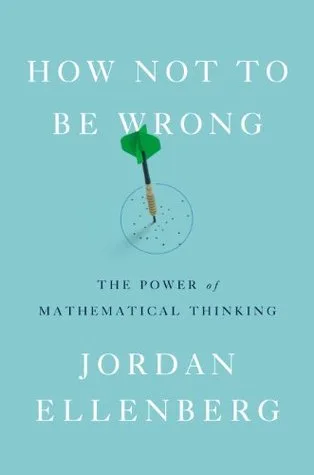
How Not to Be Wrong: The Power of Mathematical Thinking
Jordan Ellenberg argues that mathematics is not a collection of abstract rules but a refined extension of common sense. He explains how mathematical principles like linearity, regression to the mean, and the law of large numbers apply to daily life. Using concrete examples, he analyzes why a state with the highest rate of kidney cancer might also have the lowest, how Abraham Wald saved military planes in World War II by understanding survivorship bias, and why the Massachusetts state lottery was vulnerable to a group of MIT students. The text focuses on identifying when a logical premise is pushed too far or when statistical data is misinterpreted to fit a preconceived narrative.
People who enjoy analytical puzzles or logic problems read this book to sharpen their critical thinking skills. It is written for readers who want to understand the hidden mechanics behind public policy debates, sports statistics, and scientific research. Instead of memorizing formulas, the reader learns to recognize the fundamental shape of a problem. They walk away with a toolkit for detecting structural errors in arguments and an understanding of how to use quantitative reasoning to avoid common cognitive traps in professional and personal decision-making.
- Published
- 2014
- Language
- EN
More by Jordan Ellenberg
See all →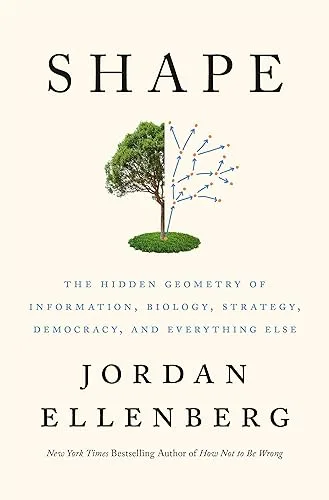
Readers also enjoyed