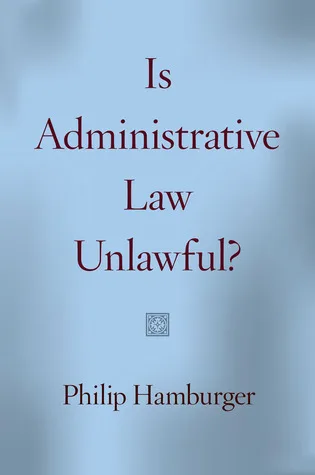
In this legal history, Philip Hamburger argues that the modern American administrative state constitutes a revival of the absolute prerogative power once claimed by English kings. He contends that when executive agencies issue binding rules and adjudicate disputes, they bypass the constitutional protections of the legislative process and the independent judiciary. Hamburger traces the development of these mechanisms from medieval royal commissions and Star Chamber proceedings to contemporary federal departments. He concludes that administrative law is not merely a modern necessity but a structural violation of the separation of powers and the rule of law.
Legal scholars, historians, and policy analysts read this work to understand the historical tensions between appointed bureaucracies and constitutional mandates. Readers gain a detailed framework for identifying how delegated authority shifts sovereign power from elected representatives to unelected officials. The book provides an analytical vocabulary for those examining the legitimacy of the regulatory state, offering a perspective that prioritizes traditional procedural safeguards over administrative efficiency. Those interested in the origins of civil liberties and the limits of executive reach will find a rigorous historical critique of institutional governance.
- Published
- 2014
- Language
- EN
More by Philip Hamburger
See all →![The United States in Literature [with three long stories] -- Seventh Edition](https://kwbjoqloympvbpzbrfja.supabase.co/storage/v1/object/public/scan-images/catalog/f48162c6-7eb5-41ec-933b-9c4218489c7d-full.webp)
Readers also enjoyed