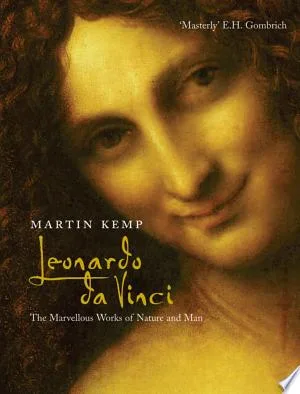
Martin Kemp presents a cohesive analysis of Leonardo da Vinci’s career by linking his artistic output to his scientific inquiries. Instead of treating painting and engineering as separate disciplines, the book explains how Leonardo applied his observations of fluid dynamics, optics, and human anatomy to works like the Mona Lisa and The Last Supper. Kemp tracks the progression of Leonardo’s thought from his early apprenticeship in Florence to his late-life technological designs, showing how he used the "science of art" to understand the mechanics of the natural world.
Art historians, students, and engineers read this volume to understand the logic behind Leonardo’s diverse experiments and sketches. Readers gain a clear perspective on how Renaissance observational techniques differs from modern scientific methodology. By the end, the reader understands the structural principles of Leonardo’s notebooks and can identify the specific biological and mathematical theories that informed his most famous portraits. It serves as a factual guide for anyone seeking to reconcile the technical precision of Leonardo’s inventions with the aesthetic harmony of his visual art.
Deep and outward-looking; a moderate read.
Best for readers like The Evidence Seeker. Which reader are you?
- Published
- 2007
- Publisher
- OUP Oxford
- ISBN
- 9780191622601
- Language
- EN