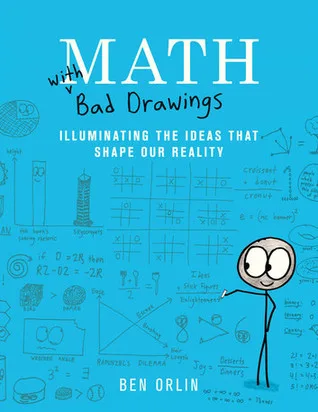
Ben Orlin uses intentionally crude stick-figure illustrations to demonstrate how mathematical thinking governs everything from professional sports strategy to the construction of skyscrapers. The text examines the geometry of dice games, the inherent flaws in the Electoral College, and the probability calculations that determine insurance premiums. By explaining concepts like fractals through the lens of coastal geography and the nuances of calculus via the trajectory of a falling ball, Orlin connects abstract equations to tangible human experiences. He breaks down the history of zero and the mechanical logic of non-Euclidean geometry.
This book is written for people who felt alienated by high school algebra or those who enjoy seeing the hidden logic of the physical world. Readers learn to identify mathematical patterns in daily news cycles, architectural designs, and economic trends. The book provides a mental toolkit for evaluating risk and understanding how simple rules create complex systems. Individuals walk away with a functional grasp of how logic applies to real-world problems without needing to solve long lists of repetitive equations.
- Published
- 2018
- Language
- EN