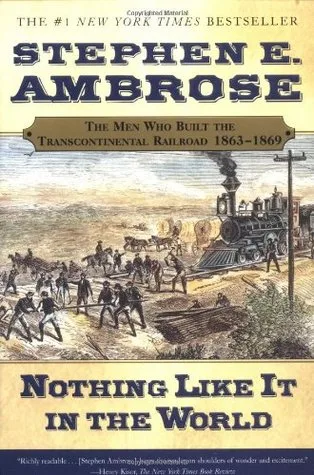
Nothing Like It in the World: The Men Who Built the Transcontinental Railroad 1863-69
In this account of the first transcontinental railroad, Stephen E. Ambrose tracks the frantic race between the Union Pacific and Central Pacific companies. The narrative chronicles the technical and logistical hurdles of moving millions of tons of iron across the Great Plains and carving tunnels through the solid granite of the Sierra Nevada. Ambrose details the daily lives of the workforce, particularly the Irish and Chinese immigrants who laid the track, as well as the financial maneuvering and corruption of the railroad tycoons involved. He describes the military-style organization required to supply thousands of men in the wilderness and the displacement of Indigenous tribes through the destruction of the buffalo.
Historians and engineers read this work to understand the mechanical and organizational requirements of nineteenth-century American expansion. Readers learn how primitive tools, black powder, and sheer manual labor connected the coasts in just six years. This book provides a clear perspective on the intersection of federal legislation, private greed, and innovative engineering. A reader walks away with a concrete understanding of how the railroad destroyed the isolation of the frontier, standardizing time and commerce across the continent while permanently altering the American landscape.
Outward-looking and clear-cut; a moderate read.
Best for readers like The Practical Optimizer. Which reader are you?
- Published
- 2000
- Language
- EN
More by Stephen E. Ambrose
See all →