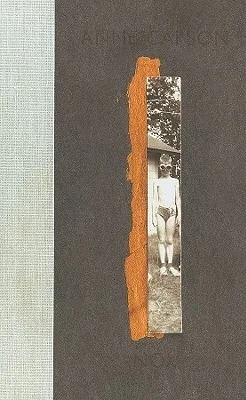
Anne Carson created this epitaph as a physical replica of a handmade scrapbook following the death of her estranged brother, Michael. The work centers on the text of Catullus 101, a Roman elegy for a sibling, which Carson translates word by word across accordion-folded pages. This fragmented memorial reconstructs Michael’s life through reproduced artifacts: grainy photographs, jagged scraps of letters, sketches, and stamps. Carson documents the impossibility of ever fully knowing another person, treating her brother’s history as a collection of mute archaeological remnants that refuse to form a coherent biography.
Readers interested in the intersection of philology and visual art approach this volume to see how grief functions as a translation exercise. Those who study the mechanics of memory will find a technical demonstration of how objects carry historical weight when words fail. The reader finishes the book with a literal grasp of the distance between a person and the bureaucratic or personal trail they leave behind. It provides a formal framework for understanding loss through the physical handling of paper, ink, and ancient syntax.
- Published
- 2010
- Language
- EN