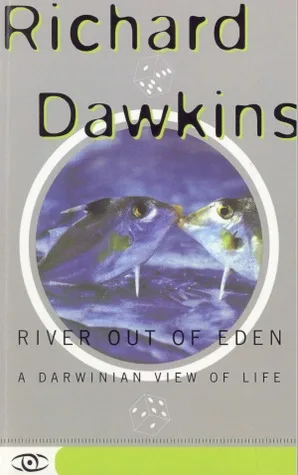
In this work, Richard Dawkins conceptualizes the flow of genetic information through time as a digital river of DNA. He clarifies that while bodies are temporary, the genetic code persists as a continuous stream of data across geological epochs. Using the concept of the "utility function," Dawkins argues that biological systems are optimized for gene survival rather than individual happiness. The text details the threshold of the "replication bomb," explaining how life spreads from its planetary origin to occupy complex ecological niches through the mechanism of natural selection.
Students of evolutionary biology and secular humanism read this volume for its rigorous focus on the gene-centered view of existence. It provides a logical framework for understanding why organisms exhibit specific behaviors and morphologies without relying on purposeful design. Readers walk away with a functional understanding of the molecular clock and the mathematical probability of speciation. The book offers a clear explanation of how complex biological features emerge from discrete instructions, stripping away mystical interpretations of the natural world in favor of algorithmic logic.
- Published
- 1995
- Language
- EN