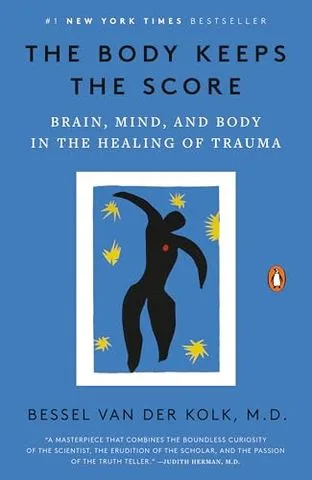
The Body Keeps the Score: Brain, Mind, and Body in the Healing of Trauma
Bessel van der Kolk explains how traumatic stress physically reconfigures the brain’s wiring, specifically impacting the amygdala, hippocampus, and prefrontal cortex. He argues that trauma is not merely a psychological event stored in memory but a physiological state where the nervous system remains stuck in a cycle of fight, flight, or freeze. The text details how sensory experiences and somatic sensations bypass the rational mind. To address this, he presents clinical findings on treatments including neurofeedback, EMDR, theater work, and yoga, which aim to restore the body’s sense of safety and agency.
Mental health professionals, survivors of abuse, and those dealing with chronic stress read this for a scientific perspective on emotional dysregulation. Readers learn why traditional talk therapy sometimes fails to reach deep-seated physiological responses. They gain an understanding of the mechanics of the vagus nerve and the importance of physical mindfulness. The book provides a technical framework for reconnecting the mind and body, leaving the reader with specific methodologies to reprogram the autonomic nervous system after high-stress events.
Insights from The Body Keeps the Score: Brain, Mind, and Body in the Healing of Trauma
“The body keeps the score.”
Trauma isn't just a mental memory. It physically changes how your brain processes the present moment. You can't just talk your way out of a body that feels under attack.
“Trauma is not just an event that took place sometime in the past.”
Flashbacks aren't just vivid thoughts. They are a total physical takeover where your internal alarm system loses its sense of time. Your brain thinks the past is happening right now.
“In order to change, people need to become aware of their sensations.”
Yoga and movement aren't just for fitness. They help people feel safe inside their own skin again. Sometimes feeling your toes on the floor is the biggest breakthrough.
“Trauma robs you of the feeling that you are in charge of yourself.”
Traumatized people often lose the ability to imagine a future. Their minds are so busy surviving the present that there is no room for dreams. Healing means regaining that sense of possibility.
- Published
- 2014
- Publisher
- Penguin
- ISBN
- 9781101608302
- Language
- EN