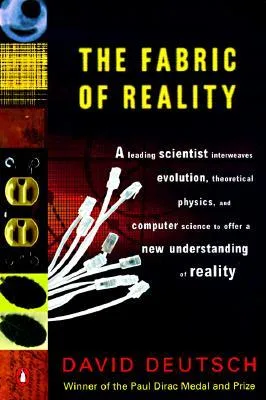
The Fabric of Reality: The Science of Parallel Universes--and Its Implications
David Deutsch integrates four major scientific and philosophical theories into a unified worldview that he identifies as the fabric of reality. He argues that human knowledge is best understood through the combination of Hugh Everett’s many-worlds interpretation of quantum mechanics, Karl Popper’s epistemology of conjecture and refutation, Charles Darwin’s theory of natural selection, and Alan Turing’s theory of universal computation. By linking these disparate fields, Deutsch explains how physical reality consists of an infinite multiverse where every possible outcome occurs, while objective knowledge grows through the correction of errors. He rejects reductionism, suggesting that information and life are as fundamental to the universe as subatomic particles.
General science readers and students of philosophy read this book to understand how complex systems across different disciplines connect. The text provides a framework for conceptualizing the existence of parallel universes and the reach of human reason. Readers gain a specific perspective on the limits and possibilities of virtual reality and quantum computing as tools for understanding existence. By the end, they possess a coherent explanation of how physical laws allow for the creation of new knowledge and why the multiverse is a necessary consequence of scientific evidence.
- Published
- 1996
- Language
- EN