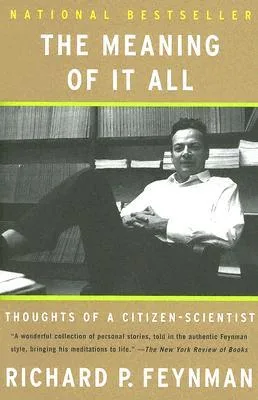
The Meaning of It All: Thoughts of a Citizen-Scientist
In 1963, Nobel laureate Richard Feynman delivered three lectures at the University of Washington that now form this collection. He argues that scientific methodology is defined by a commitment to doubt and the honest admission of ignorance. Feynman describes the intellectual tension between scientific evidence and religious belief, the dangers of socio-political dogma, and the rise of pseudoscience. He examines how the scientific process—checking ideas against observations and rejecting what fails the test—functions as a necessary tool for democratic governance and ethical decision-making.
Students of physics and history read this book to understand the intersection of technical logic and social responsibility. It serves those interested in the philosophy of science who want a practical explanation of why uncertainty is a strength rather than a flaw. Readers walk away with a framework for identifying logical fallacies in public discourse and a clearer perspective on the limitations of human knowledge. The text provides a mental toolkit for evaluating claims in an era of misinformation.
Outward-looking; a moderate read.
Best for readers like The Evidence Seeker. Which reader are you?
- Published
- 1998
- Language
- EN
More by Richard P. Feynman
See all →