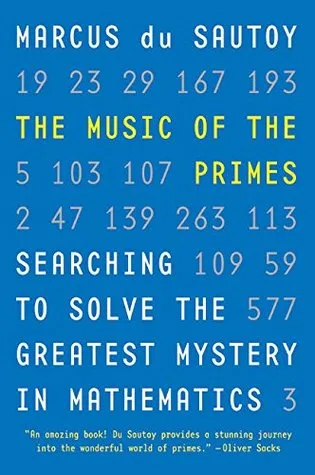
Marcus du Sautoy tracks the historical pursuit of the Riemann Hypothesis, a conjecture linking the distribution of prime numbers to the zeros of the Riemann zeta function. The narrative centers on Bernhard Riemann’s 1859 discovery that primes follow a predictable pattern resembling a musical harmony. The text details how mathematicians like Leonhard Euler, Carl Friedrich Gauss, and David Hilbert attempted to bridge the gap between chaotic arithmetic and structured geometry. It also examines the practical evolution of number theory, from abstract Victorian mental exercises to the modern implementation of RSA encryption and high-level quantum physics.
Mathematics students and science history enthusiasts read this book to understand the mechanics of number theory without needing a degree in analysis. Readers learn why prime numbers function as the fundamental atoms of arithmetic and how the lack of a proof for the Riemann Hypothesis impacts digital security. The book provides a technical timeline of how human logic tackles the concept of infinity. It leaves the reader with a clear grasp of how specialized research in pure mathematics dictates the security protocols of global finance and electronic communication.
- Published
- 2003
- Language
- EN
More by Marcus du Sautoy
See all →

Readers also enjoyed