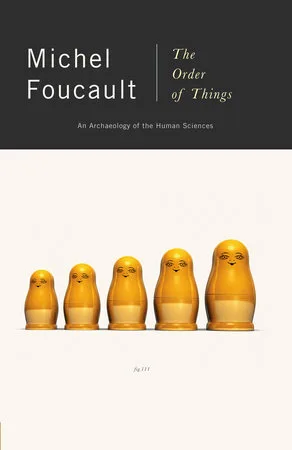
The Order of Things: An Archaeology of the Human Sciences
Michel Foucault maps the transformation of Western knowledge from the Renaissance to the modern era through the concept of the episteme. He argues that every historical period operates under a hidden grid of rules that dictates what can be thought or said. The text tracks the movement from the Renaissance focus on resemblance to the Classical emphasis on categorization, ultimately reaching the modern period's birth of "man" as an object of study. Foucault analyzes how the fields of natural history, linguistics, and political economy shifted into biology, philology, and economics.
Students of philosophy and social theory use this text to understand how historical shifts in power and language dictate the structure of science. It serves readers interested in the historiography of ideas and the philosophical collapse of humanism. The reader gains a framework for viewing objective truth as a historical construct shaped by deep, unconscious structures of discourse. By the end, they grasp why Foucault famously predicts the disappearance of the human subject as a central figure in intellectual history.
- Published
- 1966
- Language
- EN
More by Michel Foucault
See all →
Readers also enjoyed