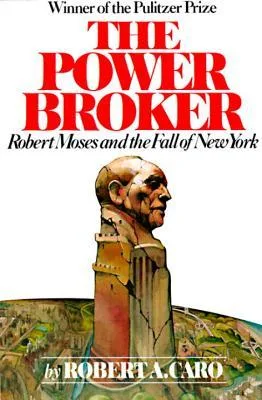
The Power Broker: Robert Moses and the Fall of New York
Robert Caro’s biography tracks the career of Robert Moses, a public official who reshaped New York through the construction of bridges, highways, and public parks without ever being elected to office. The narrative explains how Moses accumulated unprecedented authority by drafting legislation that created independent public authorities, effectively shielding his projects from democratic oversight and mayoral control. Caro documents the physical displacement of hundreds of thousands of residents and the deliberate design of infrastructure to favor automobile travel over mass transit, detailing how one man’s specific vision dictated the urban development of an entire region for forty years.
Students of political science and urban planning read this work to understand the mechanics of bureaucratic power and the consequences of top-down engineering. It serves as a case study in how individuals can exploit legal loopholes to bypass the legislative process and public will. Readers gain a technical understanding of high-level patronage systems and how municipal financing can be used to consolidate permanent influence. The book provides a historical framework for analyzing modern infrastructure policies and the long-term social impact of large-scale public works.
Insights from The Power Broker: Robert Moses and the Fall of New York
Building more roads almost always creates more traffic. Every bridge he opened was jammed with cars within a few months.
He chose to build parking lots instead of subway lines. That single decision trapped New York in a cycle of car dependency for a century.
“He loved the public but he hated the people.”
Great things get built by people who refuse to take no for an answer. Eventually that same stubbornness turns into a total lack of empathy.
“The city was being shaped by a man who had never even learned to drive.”
Robert Moses started out as an idealistic reformer. He ended up building highways directly through neighborhoods just because he could.
- Published
- 1974
- Language
- EN