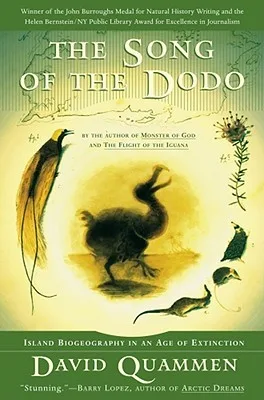
The Song of the Dodo: Island Biogeography in an Age of Extinction
David Quammen chronicles the history of island biogeography, tracing its origins from Alfred Russel Wallace’s observations in the Malay Archipelago to the mathematical equilibrium theory developed by Robert MacArthur and Edward O. Wilson. The narrative explains how geographic isolation drives the evolution of unique species while simultaneously increasing their vulnerability to extinction. Quammen examines concrete phenomena like the arrival of the brown tree snake in Guam and the disappearance of the dodo to illustrate how habitat fragmentation turns mainland forests into ecological islands, leading to rapid biodiversity loss.
This book serves students of ecology and readers interested in the mechanics of conservation biology. It provides a technical yet accessible framework for understanding why small, disconnected populations face higher risks of collapse. Readers gain a clear perspective on the logic behind wildlife corridors and the design of nature reserves. By the end, they understand the specific mathematical and biological pressures that cause species to vanish in a fragmented world, shifting their view of the natural landscape from a continuous whole into a collection of fragile patches.
- Published
- 1996
- Language
- EN
More by David Quammen
See all →