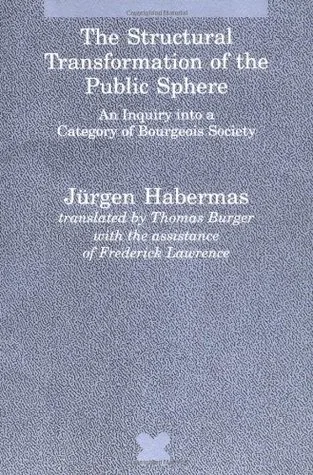
The Structural Transformation of the Public Sphere: An Inquiry into a Category of Bourgeois Society
Habermas tracks the historical rise and subsequent decline of the bourgeois public sphere as a distinct space between the state and private life. He argues that in eighteenth-century coffee houses and salons, private individuals engaged in rational-critical debate to hold state power accountable through public opinion. This ideal shifted with the rise of mass media and consumer culture. Habermas identifies a process of re-feudalization, where powerful interest groups and manipulative public relations replace genuine deliberation, turning active citizens into passive consumers of political spectacles and managed consensus.
Political theorists and sociologists study this text to understand how democratic discourse functions within capitalist structures. Readers gain a framework for analyzing how media consolidation and institutional bureaucracies affect the quality of civic participation. The book provides the conceptual tools to distinguish between manipulated publicity and authentic communicative action. By examining the transition from institutionalized debate to private consumption, the reader develops a critical perspective on the structural limitations of modern democratic engagement and the requirements for a functioning civil society.
- Published
- 1962
- Language
- EN