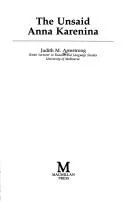
Judith M. Armstrong applies a psychoanalytic lens to Leo Tolstoy’s classic text, focusing on the subconscious motivations and repressed desires that drive Anna and Levin. She evaluates how the narrative structure reflects nineteenth-century Russian social hierarchies and gendered expectations. The analysis centers on the conflict between individual psychology and the rigid moral frameworks of the era. Armstrong explains how the unspoken tensions within the prose reveal Tolstoy’s own complicated attitudes toward female sexuality, maternal duty, and the preservation of his characters' domestic integrity.
Students and scholars of Russian literature read this work to gain a technical understanding of character development and narrative theory. The book serves those interested in how Freudian concepts apply to Victorian-era realism. Readers walk away with a specific framework for identifying hidden psychological subtexts within the dialogue and internal monologues of the novel. It provides a toolkit for analyzing how silence and omissions within a story can carry as much significance as the explicit plot events.
Deep; a demanding read.
Best for readers like The Wisdom Collector. Which reader are you?
- Published
- 1988
- Language
- EN

