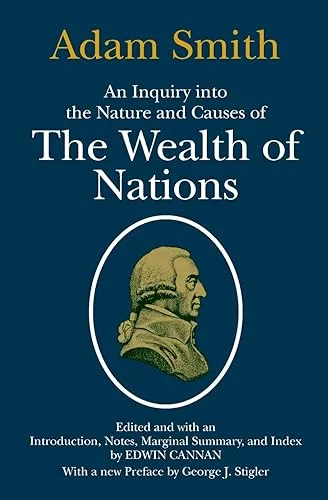
Adam Smith examines how a country’s standard of living rises through the division of labor and the accumulation of capital. He argues against mercantilist policies, such as high tariffs and state-granted monopolies, which favor gold reserves over productive output. Instead, he describes a system where individuals pursuing their own profit inadvertently promote the public interest through market competition. Smith details how price mechanisms coordinate supply and demand, the functions of money, the history of European trade, and the necessity of public infrastructure and defense.
This text is for students of political economy and readers interested in the historical development of capitalism. It provides a technical vocabulary for understanding trade balances, productivity, and tax structures. Readers walk away with a framework for analyzing how government intervention affects market efficiency and a clear perspective on the transition from feudal systems to commercial societies. It functions as a foundational reference for those evaluating the relationship between individual liberty and state economic policy.
- Published
- 1776
- Language
- EN