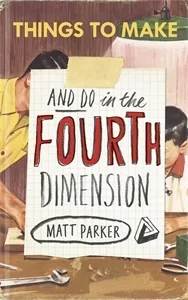
Matt Parker uses mathematical recreationalism to examine concepts ranging from basic geometry to complex topology. He explains how to construct a cardboard computer, details the properties of prime numbers, and illustrates the mechanics of four-dimensional shapes like hypercubes. The text includes physical activities, such as tying knots in specific patterns and folding paper to demonstrate geometric principles. Parker highlights the peculiarities of high-dimensional space and the historical development of number systems, moving from elementary counting into the abstract territory of transfinite sets.
This book is intended for hobbyists and students who value a hands-on approach to abstract reasoning. Readers gain the ability to visualize spatial anomalies and understand the logic behind cryptographic primes. It serves those who want to see the mechanics behind the formulas through tangible examples and playful experiments. People read it to bridge the gap between classroom theory and the chaotic application of math in the physical world, walking away with a toolkit for solving recreational puzzles and a clearer mental model of the fourth dimension.
- Published
- 2014
- Language
- EN