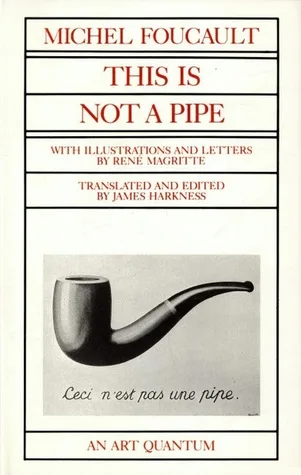
Michel Foucault analyzes René Magritte’s famous painting of a tobacco pipe accompanied by a contradictory caption. He examines the friction between linguistic labels and visual representation, arguing that the image breaks the traditional bond between a physical object and its name. Foucault identifies the painting as a calligram that has been unraveled, forcing the viewer to confront the disconnect between the painted stroke, the spoken word, and the actual thing. He compares Magritte’s subversion of resemblance to the work of Paul Klee and Wassily Kandinsky, demonstrating how modern art replaces imitation with autonomous systems of signs.
Art historians and students of semiotics read this text to understand how meaning is constructed through visual symbols and text. It appeals to readers interested in structuralism and the philosophy of language. The reader learns to identify the hidden mechanisms of perception and the arbitrary nature of representation. By the end, they possess a framework for questioning the relationship between reality and the images used to depict it.
- Published
- 1968
- Language
- EN