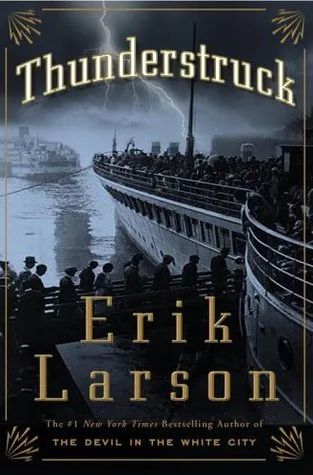
Erik Larson weaves together two seemingly unrelated narratives from the Edwardian era: the invention of long-distance wireless communication by Guglielmo Marconi and the pursuit of the mild-mannered murderer Hawley Harvey Crippen. Marconi struggles with scientific skepticism and technical failures while obsessively trying to prove radio waves can cross the Atlantic. Simultaneously, Dr. Crippen kills his wife in London and flees toward Canada with his lover. The two storylines converge on the high seas when the captain of the SS Montrose uses Marconi’s new technology to alert Scotland Yard that the fugitives are on his ship, marking the first time wireless telegraphy facilitated a high-profile criminal arrest.
This book serves readers of historical non-fiction who value technical detail alongside true crime. It appeals to those interested in the friction between scientific progress and social norms at the turn of the century. Readers gain a thorough understanding of early physics and the competitive race to control global communication. By the end, the audience understands how a niche invention became a tool for international law enforcement, permanently shrinking the world for both scientists and criminals.
- Published
- 2006
- Language
- EN
More by Erik Larson
See all →





Readers also enjoyed