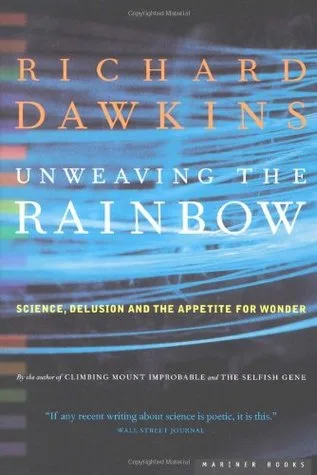
Unweaving the Rainbow: Science, Delusion and the Appetite for Wonder
Richard Dawkins addresses the accusation that scientific analysis strips the world of its beauty, specifically responding to John Keats’s claim that Isaac Newton destroyed the poetry of the rainbow by explaining its optics. Dawkins argues that understanding the physical world elevates aesthetic appreciation rather than diminishing it. He uses examples from spectrum analysis, which reveals the chemical composition of distant stars, and digital code in DNA to demonstrate how nature operates like a grand, intricate mechanism. The text examines how human pattern recognition can lead to superstition when applied to astrology or coincidence, suggesting that statistical probability and hard evidence provide a more profound sense of awe than paranormal myths.
Readers interested in the intersection of evolutionary biology and philosophy often choose this work to find a rational basis for wonder. It appeals to those who want a defense of the scientific method against claims that it is cold or reductionist. The audience learns to identify logical fallacies in pseudoscience while gaining a deeper perspective on how light, sound, and genetic data convey information about the history of life. A reader finishes the book with a framework for viewing reality through a lens of evidence-based curiosity, replacing supernatural explanations with the complexities of the natural world.
- Published
- 2000
- Language
- EN