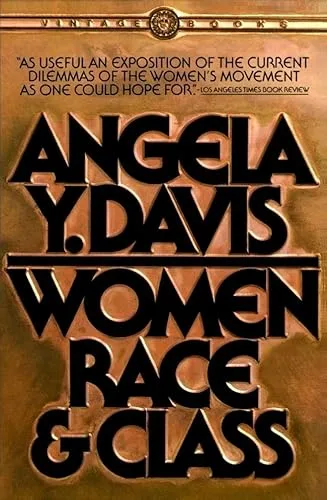
Angela Davis maps the historical intersection of abolitionism and the early women’s suffrage movement to demonstrate how the priorities of middle-class white women often excluded the needs of Black women. She documents the specific economic conditions of enslaved women, whose labor under plantation capitalism blurred traditional gender roles. The text identifies how the 19th-century focus on domesticity and the right to vote bypassed the systemic violence and labor exploitation faced by women of color, eventually leading to the racist rhetoric used by some suffragists to gain political leverage.
Historians and activists read this work to understand the origins of intersectional analysis within American political movements. It provides a corrective to traditional feminist histories by centering the experiences of working-class Black women and their unique relationship to reproductive rights and industrial labor. Readers gain a framework for analyzing how social movements fail when they treat gender as a category isolated from race and economic status. The book offers a clear explanation of why liberation strategies must address multiple systems of oppression simultaneously to be effective.
- Published
- 1981
- Language
- EN
More by Angela Y. Davis
See all →
Readers also enjoyed