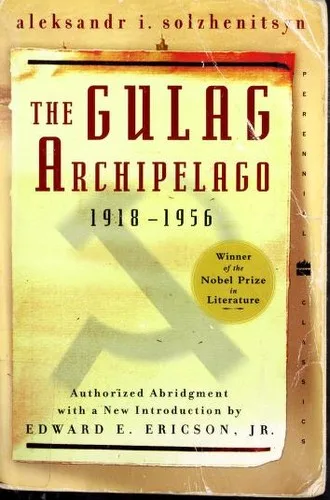
Aleksandr Solzhenitsyn defines the Gulag as a hidden country within a country, a vast network of prison islands connected by the secret transport of the Bluecaps. The narrative reconstructs the mechanics of the Soviet penal system from 1918 to 1956, documenting the progression from initial arrest and night interrogations to the transit camps and internal exile. He uses his own eight-year imprisonment and the testimonies of 227 survivors to detail specific irrigation and mining projects, such as the White Sea Canal, where forced labor resulted in mass mortality. The text explains the legal framework of Article 58, the psychological methods used to extract confessions, and the varying hierarchies between political prisoners and common criminals.
Historians and descendants of the victims read this work to find a precise record of state-sponsored repression and the structural evolution of the NKVD. The reader learns the specific logistics of the Soviet police state and how individual prisoners managed to maintain their integrity or succumbed to the pressures of the system. By finishing the volume, a reader ignores political abstractions and instead understands the physical reality of the labor camps, the legal justifications for the Great Purge, and the methods used to sustain a permanent underclass of prisoners for economic gain.
- Published
- 1970
- Language
- EN