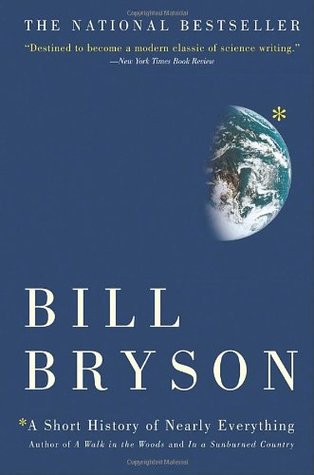
A Short History of Nearly Everything
Bill Bryson tracks the development of human understanding from the Big Bang to the arrival of modern civilization. The narrative avoids abstract theory in favor of chronicling how scientists measured the age of the Earth via lead levels, established the basics of atomic structure, and mapped the fossil record. It details the specific physical realities of plate tectonics, cellular biology, and the sheer scale of the cosmos. Bryson documents the actual field work, highlighting the eccentric personalities and accidental discoveries that shaped chemistry, geology, and particle physics.
Science enthusiasts and history buffs read this book to understand the mechanisms of the universe without technical jargon. Readers walk away with a functional grasp of how various scientific disciplines fit together and an appreciation for the specific conditions required for life to exist. The text provides a clear sense of the timeline of the natural world and the scale of the physical environment, leaving the reader with a concrete perspective on the fragility and complexity of human existence within the solar system.
Outward-looking and clear-cut; a moderate read.
Best for readers like The Evidence Seeker. Which reader are you?
Insights from A Short History of Nearly Everything
“To be here now, you needed trillions of drifting atoms to somehow assemble in an intricate and curiously obliging manner.”
Every atom in your body comes from a dying star. You are basically recycled space dust just trying to figure itself out.
“We live on a crust that is relatively thinner than the skin of an apple.”
The earth is way more fragile than I thought. We are basically living on a thin crust floating over a massive ball of fire.
“If you were to compile a history of the Earth, you would be incredibly lucky to find yourself in it at all.”
Evolution is just a long string of lucky breaks. If one tiny fish hadn't crawled out of the mud, we wouldn't exist.
“We know more about the topography of Mars than we do about the Earth’s ocean floor.”
Oceans are still mostly a mystery to us. We have better maps of Mars than we do of our own deep sea floors.
- Published
- 2003
- Publisher
- Crown
- ISBN
- 9780307885166
- Language
- EN