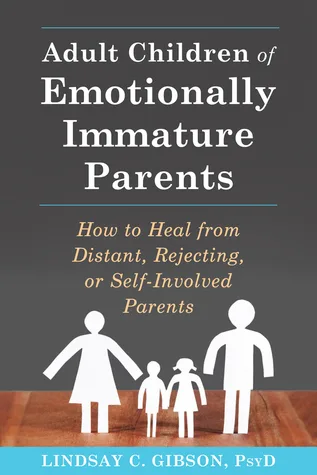
Adult Children of Emotionally Immature Parents: How to Heal from Distant, Rejecting, or Self-Involved Parents
Lindsay C. Gibson identifies four specific types of emotionally stunted caregivers: the emotional parent, the driven parent, the passive parent, and the rejecting parent. She argues that these individuals lack the psychological resources to provide emotional intimacy, often leaving their children to cope through "internalizer" or "externalizer" behavioral patterns. Internalizers tend to sacrifice their own needs to keep the peace, while externalizers look for outside sources to solve their inner distress. The text diagnostic tools help readers identify signs of emotional immaturity, such as poor empathy and low distress tolerance, and explains how these traits manifest in adult relationship dynamics.
This book serves adults who grew up feeling invisible or responsible for their parents' stability. Readers typically seek this material to understand why they feel lonely even in close connections or why they struggle with chronic guilt. By applying the "observation-only" technique, readers learn to set boundaries and interact with reactive family members without becoming entangled in their drama. The final sections provide a framework for recognizing emotionally mature people, helping the reader build a support system based on mutual respect and genuine emotional exchange.
Insights from Adult Children of Emotionally Immature Parents: How to Heal from Distant, Rejecting, or Self-Involved Parents
“Emotional loneliness is a vague and private experience, not easy to see or describe.”
Living with an emotionally shallow parent feels incredibly lonely. You end up doing all the emotional heavy lifting just to stay connected.
“They may be very effective at getting things done, yet have little or no awareness of their own or others’ feelings.”
Some parents only care about how things look on the outside. They might provide everything physically but leave your inner world completely starving.
“Internalizers believe it’s up to them to change their lives, while externalizers wait for someone else to do it.”
Internalizers always try to solve the problem by changing themselves. It leads to a cycle of over-functioning while the other person stays exactly the same.
“You can’t have a deep, intimate relationship with someone who is afraid of their own feelings.”
You can finally stop waiting for them to suddenly become deep or self-aware. Accepting their limitations is the only way to feel some peace.
- Published
- 2015
- Language
- EN
More by Lindsay C. Gibson
See all →