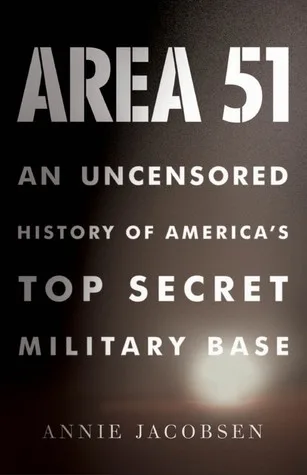
Area 51: An Uncensored History of America's Top Secret Military Base
Annie Jacobsen tracks the evolution of the Nevada Test and Training Range from its inception as a U-2 spy plane testing site to its role in Cold War aerospace innovation. Drawing on interviews with seventy-four individuals who lived and worked on the base, the narrative details the development of stealth technology, supersonic reconnaissance aircraft like the A-12 OXCART, and the testing of nuclear thermal rockets. Jacobsen argues that the facility served as a laboratory for the military-industrial complex to build high-altitude intelligence platforms while maintaining a cover of total secrecy. She addresses the 1947 Roswell incident by presenting a controversial theory involving Soviet psychological warfare and horten-style aircraft designed to incite American panic.
Historians and fans of military technology read this book to understand the logistical reality of classified government operations. It appeals to readers interested in aerospace engineering and the bureaucratic mechanisms of the CIA and the Atomic Energy Commission. The reader gains a factual timeline of experimental flight testing and nuclear fragmentation studies. By separating technical achievements from popular science fiction, the text provides a clear view of how the United States government manages top-secret assets during geopolitical crises.
Insights from Area 51: An Uncensored History of America's Top Secret Military Base
“The U-2 was the original UFO.”
Most UFO sightings were actually just pilots seeing the U-2 spy plane. The titanium skin reflected sunlight at high altitudes. It looked like a glowing orb to anyone on the ground.
“Secrecy is a form of government power.”
Engineers at the base lived in total isolation for weeks. They could not even tell their wives where they were going. The secrecy was more intense than the work itself.
“The lie was always more useful than the truth.”
The government used the public's obsession with aliens as a convenient cover. It was easier to let people believe in Martians than admit to illegal overhead surveillance. Paranoia served the military perfectly.
Radiation testing at the site was incredibly reckless. Workers were often exposed to fallout without proper protection or warnings. They were patriotic guinea pigs for the nuclear age.
- Published
- 2011
- Language
- EN
More by Annie Jacobsen
See all →



Readers also enjoyed