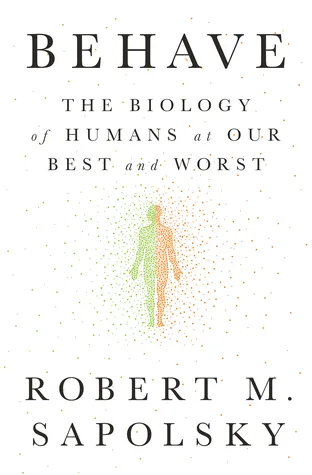
Behave: The Biology of Humans at Our Best and Worst
Robert Sapolsky explains human action by tracing its origins across different timescales, starting seconds before a behavior occurs and moving back through centuries. This framework begins with neurobiology, specifically the role of the amygdala in fear and the frontal cortex in impulse control. He examines how testosterone and oxytocin influence social bonding or aggression, then shifts to how childhood experiences shape the developing brain. The narrative extends further to genetic inheritance, cultural history, and the evolutionary pressures that dictated how our species navigates cooperation and conflict. By connecting dopamine spikes to ancient ecological adaptations, the book explains why humans exhibit both extreme tribalism and remarkable altruism.
Casual students of psychology and neurobiology read this to understand the physical mechanisms behind moral decision-making. It appeals to those interested in how social structures and biological impulses intersect to create political ideologies or criminal behavior. Readers walk away with a functional understanding of the brain's circuitry and an awareness of how environment modifies genetic expression. The book provides a technical basis for evaluating why people favor their own groups and how the capacity for empathy can be expanded or suppressed by external circumstances.
Insights from Behave: The Biology of Humans at Our Best and Worst
The amygdala can make you pull a trigger in milliseconds. It doesn't care about the truth. It only cares about fear.
“Oxytocin makes us more prosocial to Us and more crappy to Them.”
Oxytocin isn't a hug drug. It makes you nicer to your friends but way meaner to strangers.
“The same biology can lead to the best and worst of our behaviors.”
The same neurobiology that creates a suicide bomber also creates a saint. Context is the only thing that changes the outcome.
“The brain is the final common pathway.”
Your brain decides to act before you even realize it. Free will is mostly just biology catching up to a chemical signal.
- Published
- 2017
- Publisher
- Vintage
- ISBN
- 9781529116083
- Language
- EN
More by Robert M. Sapolsky
See all →