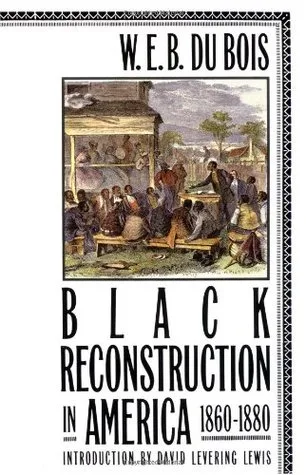
In this historical treatise, W.E.B. Du Bois refutes the Dunning School perspective that portrayed the Reconstruction era as a failure of Black governance. He presents the Civil War as a general strike wherein enslaved workers abandoned plantations to force a Union victory and emancipation. Du Bois argues that the subsequent period was a brief experiment in interracial democracy, characterized by the establishment of public school systems and civil rights legislation. He details how the eventual collapse of these efforts resulted from a "psychological wage" of racial superiority offered to white laborers, which prevented a unified working-class movement against the planter elite.
Students of political economy and American history read this text to understand the structural origins of racial capitalism and labor division in the United States. It provides a framework for analyzing how state policy and economic interests intersect to suppress democratic participation. The reader gains a specific historical foundation for why the Reconstruction project ended in systemic disenfranchisement rather than economic parity. By studying Du Bois’s use of census data and legislative records, the reader learns to interpret the role of Black agency in shaping national politics.
- Published
- 1935
- Language
- EN