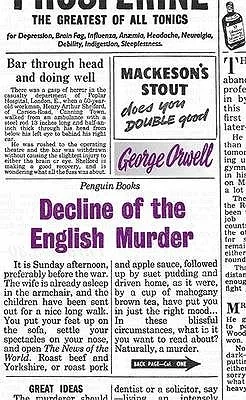
In this 1946 essay, George Orwell analyzes the shifting nature of British sensationalism and public interest in homicide. He defines the classic English murder as a mid-Victorian domestic tragedy involving a respectable professional, such as a doctor or solicitor, who commits a calculated act of violence to avoid a social scandal. Orwell contrasts these intricate, motive-driven crimes of the past with the casual, nihilistic violence of the Second World War era, exemplified by the Cleft Chin Murder. He argues that the loss of traditional moral frameworks and the rise of Americanized pulp culture have replaced psychological complexity with mindless brutality.
Social historians and students of British culture read this piece to understand how national identity is reflected in popular entertainment. It appeals to those interested in the sociology of the press and the evolution of the true crime genre. The reader walks away with a framework for identifying how changes in class dynamics and international influence alter a society’s subconscious desires. By the end, one understands Orwell's view that even a nation's taste in tabloid scandals reveals a decline in its internal consistency and traditional values.
- Published
- 1946
- Language
- EN
Quotes by George Orwell
More →Who controls the past controls the future. Who controls the present controls the past.
1984
All animals are equal, but some animals are more equal than others.
Animal Farm
In a time of deceit, telling the truth is a revolutionary act.
More by George Orwell
See all →


Readers also enjoyed