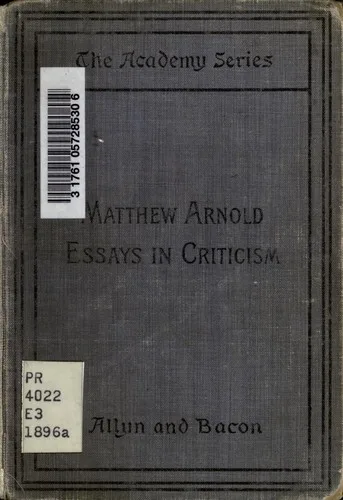
Matthew Arnold’s collection, Essays in Criticism, advocates for an intellectual framework he defines as disinterestedness. He argues that the critic must remain detached from political and sectarian agendas to perceive the object as it truly is. Through studies of figures like Maurice de Guérin, Heinrich Heine, and Marcus Aurelius, Arnold establishes a standard for European high culture. He critiques the provinciality of English intellectual life, proposing that the function of criticism is to circulate the best ideas available to humanity to foster a more sophisticated society.
This volume serves students of Victorian literature and historians of aesthetic theory. Readers use these texts to understand the transition from Romanticism to modern cultural studies. By engaging with Arnold’s prose, a reader gains a vocabulary for evaluating poetry and philosophy based on their contribution to human excellence rather than immediate utility. They finish the book with a clear methodology for identifying cultural value in an increasingly industrialized world.
- Published
- 1865
- Language
- EN
More by Matthew Arnold
See all →
Readers also enjoyed