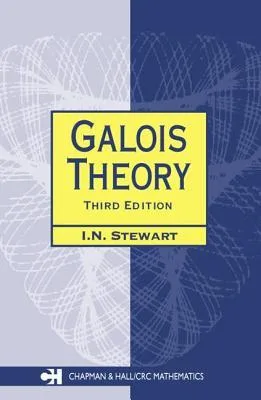
Ian Stewart provides a mathematical treatment of the relationship between group theory and field theory to solve the historical problem of quintic equations. The text formalizes the concept of field extensions and automorphisms to demonstrate why no general algebraic formula exists for solving polynomials of degree five or higher. Stewart reconstructs Evariste Galois’s insights through modern algebraic notation, covering ruler-and-compass constructions, the insolubility of the doubling of the cube, and the properties of radicals. Concrete proofs address the discriminant, splitting fields, and the fundamental theorem of Galois theory.
This book is intended for undergraduate mathematics students and instructors focusing on abstract algebra. Readers use it to bridge the gap between basic polynomial arithmetic and advanced field extensions. By following the structured proofs, the reader gains a functional technical understanding of how symmetry groups dictate the behavior of equation roots. It serves as a pedagogical bridge that prepares mathematicians for graduate research in number theory or algebraic geometry through rigorous, step-by-step logical derivation.
- Published
- 1989
- Language
- EN