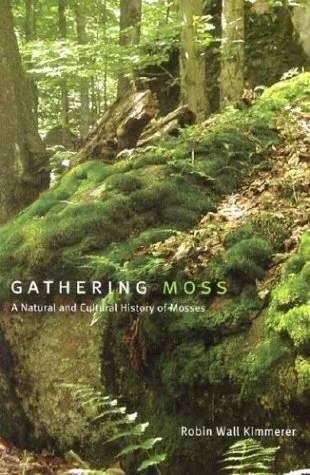
Gathering Moss: A Natural and Cultural History of Mosses
Robin Wall Kimmerer examines the biology of bryophytes through a dual lens of botanical science and Indigenous traditional knowledge. She explains the physical mechanisms of mosses, such as their lack of vascular tissue, their reliance on capillary action for water transport, and their reproductive cycles involving spores and swimming sperm. By observing these organisms at the boundary layer—the thin pocket of still air near the ground—she identifies how their small stature allows them to thrive in harsh environments. Kimmerer connects these biological traits to human values of persistence, reciprocity, and ecological balance.
Naturalists and students of biology find here a technical yet accessible guide to the overlooked micro-ecosystems underfoot. Readers finish the book with a precise vocabulary for distinguishing species and an understanding of how miniature forests support entire communities of invertebrates. It provides a framework for practicing "slow looking," shifting the scale of observation from the broad landscape to the intricate details of a single rock or log. The reader acquires a renewed spatial perspective on the interdependence of life forms across different biological scales.
- Published
- 2003
- Language
- EN