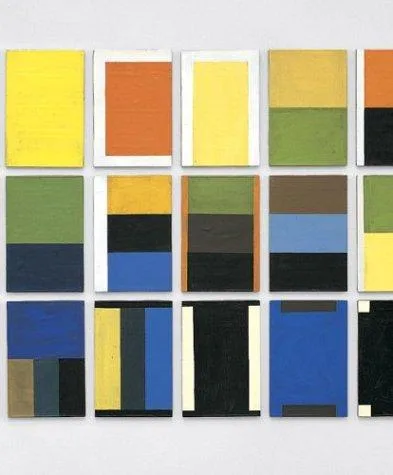
This 1984 publication documents the early interdisciplinary work of Günther Förg, focusing on the intersection of modernist architecture and large-scale photographic reproduction. The volume details his use of grainy, high-contrast black-and-white photography to capture Rationalist structures, such as the Wittgenstein House and Italian fascist-era buildings. These images are presented alongside his monochromatic paintings and wall works, demonstrating how architectural space dictates the viewer's physical movement. Contributions from Rudolf Schmitz and Achim Preiss analyze the specific spatial relationships between the structural grid, the polished surface of the lead paintings, and the reflective glass of the framed photographs.
Architectural historians and students of contemporary art read this book to understand the development of German post-minimalism and the legacy of the Bauhaus. The reader gains a technical perspective on how photography functions as a sculptural element within a gallery environment rather than a mere representational tool. It provides a formal breakdown of how heavy materials like lead and aluminum are used to ground visual art in the physical reality of the built environment. After reading, the audience has a clear framework for how 20th-century history is recontextualized through architectural geometry.
- Published
- 1984
- Language
- EN