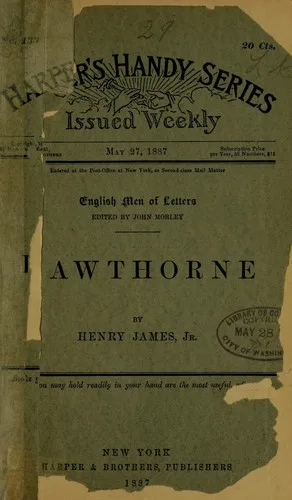
Henry James analyzes the development of Nathaniel Hawthorne’s literary career against the backdrop of colonial New England's rigid morality. He argues that the American environment of the mid-nineteenth century lacked the complex social hierarchies, ancient institutions, and dense cultural history required to produce sophisticated novels. Using Hawthorne’s journals and major works like The Scarlet Letter, James details how a writer navigated a provincial landscape defined by Puritan gloom and a thin intellectual atmosphere, ultimately transmuting these limitations into a unique form of psychological romance.
Literary historians and students of nineteenth-century American letters read this volume to understand the specific professional challenges faced by early national authors. It provides a technical look at the relationship between a writer’s surroundings and their creative output. Readers walk away with a clear perspective on the "provincialism" James believed defined the era and a specific framework for how Hawthorne’s work bridged the gap between allegory and modern realism.
- Published
- 1879
- Language
- EN

![The United States in Literature [with three long stories] -- Seventh Edition](https://kwbjoqloympvbpzbrfja.supabase.co/storage/v1/object/public/scan-images/catalog/f48162c6-7eb5-41ec-933b-9c4218489c7d-full.webp)