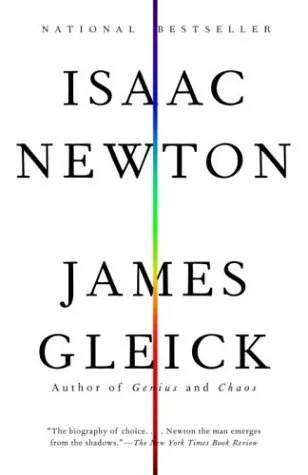
James Gleick portrays Isaac Newton as a solitary figure who reshaped human understanding through the creation of calculus, the laws of motion, and the theory of universal gravitation. The narrative details how Newton lived in a transitional era where experimental science coexisted with alchemy and secretive biblical chronology. Gleick follows Newton’s academic isolation at Cambridge, his caustic disputes with Robert Hooke over optics, and his leadership at the Royal Mint. The text explains how Newton replaced a chaotic universe with a mathematical system governed by absolute time and space.
Science enthusiasts and history students read this book to understand the specific intellectual shift from medieval philosophy to the Enlightenment. It appeals to readers interested in the internal friction between a genius’s public discoveries and his private obsessions with the occult. The reader gains a clear perspective on how Newton’s mechanical laws provided the foundation for modern physics. They walk away with a technical grasp of how one individual formalized the invisible forces of the natural world into precise equations.
- Published
- 2003
- Language
- EN