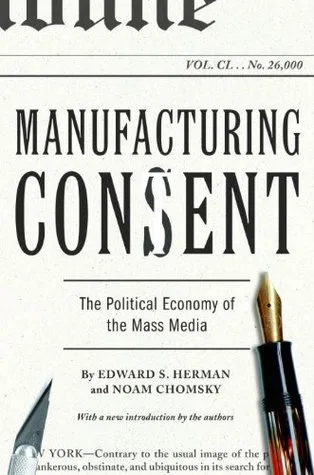
Manufacturing Consent: The Political Economy of the Mass Media
Herman and Chomsky present the propaganda model to explain how corporate and state power shapes the output of private news organizations. They identify five structural filters: ownership by massive profit-seeking corporations, dependence on advertising revenue, reliance on official government or business sources, the threat of organized flak, and the ideological framework of anticommunism. By analyzing case studies like the differing press coverage of state-sponsored atrocities in Cambodia versus East Timor, the authors argue that the media functions to marginalize dissent and manufacture public approval for elite policy.
This book serves students of journalism, political scientists, and citizens interested in the mechanics of institutional power. It provides a framework for identifying how economic incentives and systemic biases dictate what information reaches the public. Readers gain a technical understanding of why mainstream reporting often aligns with state interests without the need for overt government censorship. The text equips individuals with the analytical tools to decode news narratives and recognize the structural constraints that limit contemporary political discourse.
Deep and outward-looking; a demanding read.
Best for readers like The Evidence Seeker. Which reader are you?
- Published
- 1988
- Language
- EN