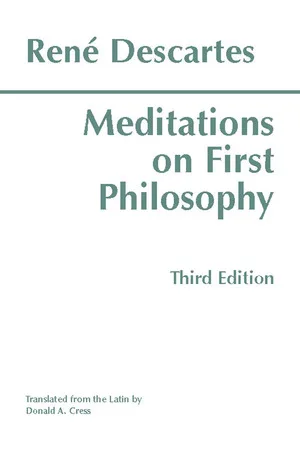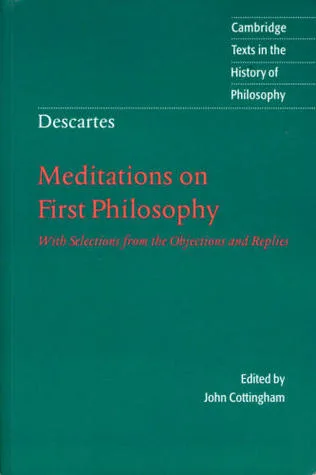
Meditations on First Philosophy, with Selections from the Objections and Replies
René Descartes establishes a foundation for certain knowledge by applying systematic doubt to all sensory data and preconceived beliefs. Through six chronological meditations, he discards any idea that lacks absolute clarity, eventually identifying the thinking self as an undeniable starting point via the cogito. He moves from this internal certainty to proving the existence of a non-deceiving God, which validates the reliability of mathematical truths and the external world. The text presents a dualistic framework that separates the mind as a thinking entity from the body as an extended physical substance.
Students of philosophy and history read this work to understand the shift from scholastic tradition to modern rationalism. Readers gain a technical vocabulary for discussing consciousness, skepticism, and the relationship between physical matter and mental states. The included objections from contemporary thinkers like Hobbes and Arnauld, along with Descartes' rebuttals, provide a model for dialectical proof and critical analysis. The book offers a logical blueprint for reconstructing a worldview based on internal reason rather than inherited authority or unverified perception.
- Published
- 1641
- Language
- EN